 রিপোর্টারের নাম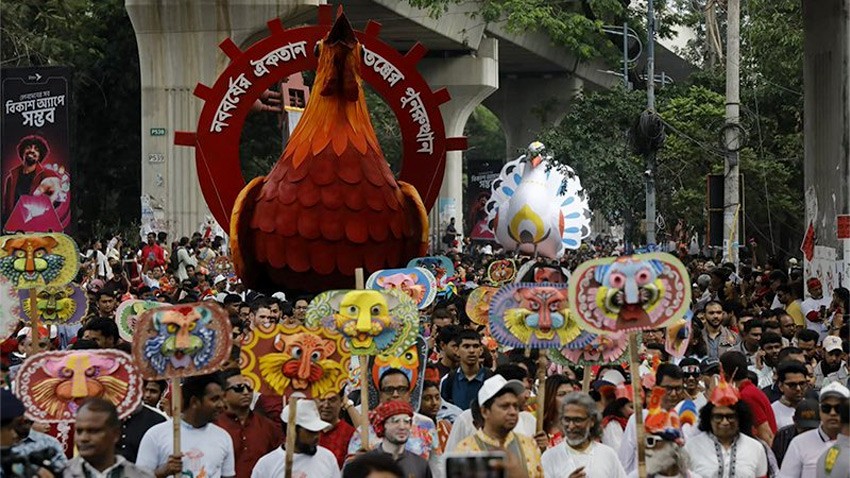
Baishakhi Shobhajatra commenced Tuesday morning from Dhaka University’s (DU) Faculty of Fine Arts, marking Pahela Baishakh with the theme ‘Noboborsher Oikotan, Gonotontrer Punoruthhan’ (Harmony of New Year, Resurgence of Democracy) as thousands from all walks of life joined the traditional procession celebrating Bangla New Year 1433.
Procession began at 9:06 am under the leadership of DU Vice-Chancellor (VC) Prof ABM Obaidul Islam, following the national anthem performed at 9:03am.
Teachers, students, officials, employees and people from all strata of society participated in the event that has become synonymous with Bangla New Year celebrations.
This year’s procession featured five principal motifs: rooster, elephant, dove, dotara and horse. Each symbol carries distinct messages reflecting contemporary social and cultural aspirations. Additionally, the procession included representations of fish, tiger cubs, deer fawns, goats, cockatoos and peacocks.
Rooster symbolises new beginnings, awakening and the arrival of light, indicating the dispelling of darkness. Dotara, representing the soul of Bengali folk music, highlights cultural roots whilst reminding viewers of the dignity of music amid undervaluation of Baul artists.
Wooden elephant, modelled after Narayanganj’s Folk Art Museum, represents folk tradition, strength and nobility. Clay horse evokes rural Bangla’s simple life and childhood memories, whilst the dove carries messages of harmony, coexistence and global peace.
Procession departed from the Faculty of Fine Arts’ Gate No 3 (North), proceeding to Shahbagh Police Station before taking a U-turn. Route then passed Raju Sculpture and TSC premises on the right, continued through Doel Chattar and passed before Bangla Academy before returning to the Fine Arts faculty.
Preparations began around 8 am as various effigies were readied for display. This year, masks were banned from being worn in the university area during Pahela Baishakh, though participants were seen displaying Faculty of Fine Arts-prepared masks by holding them in their hands rather than wearing them.
Pocession’s name has undergone significant changes reflecting evolving political and cultural dynamics. What began in the 1980s as a simple procession from DU’s Fine Arts facility later became known as Mangal Shobhajatra. UNESCO recognised it as cultural heritage in 2016, cementing its international significance.
Following the fall of the Awami League government on August 5, 2024 during the mass uprising, some religious groups began opposing Mangal Shobhajatra during Muhammad Yunus’s interim government period. In 2025, the word ‘Mangal’ was removed from the procession’s name, and it was renamed ‘Borshoboron Anondo Shobhajatra’ (New Year Joy Procession).
This year marks another renaming, with the procession now officially called Baishakhi Shobhajatra. Culture Minister Nitai Roy Chowdhury addressed the naming controversy on April 5 at the Secretariat, telling reporters, “We want to end the debate over the name of Pahela Baishakh’s procession. Pahela Baishakh is fundamentally a festival for ordinary people of all classes and farmers”.
“We are a democratic government accountable to the people. In democracy, there will be unity in diversity. From now on, the New Year procession will be held as Baishakhi Shobhajatra”, the minister said.
Despite the controversies, participation remained robust. The procession brought together DU’s academic community with broader public participation, demonstrating continued enthusiasm for Bangla New Year celebrations regardless of nomenclature changes.